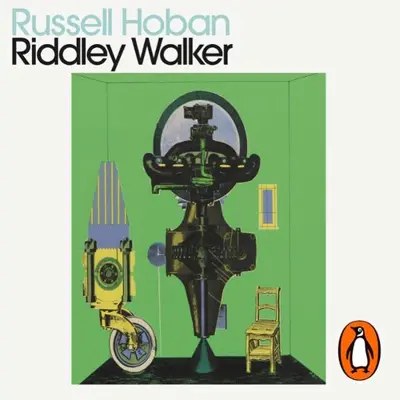
Riddley Walker
Penguin Modern Classics
Russell Hoban
- Published
- 1980
- Reviewed
- Reviewed 2 Aug 2026
Rated 3.5 out of 5.
Overall
Rated 4.5 out of 5.
Narration
Synopsis — skip if you already read the book (most likely LLM generated)
Two thousand years after a nuclear war, England has fallen back to iron-age subsistence. What remains is Kent: fenced settlements, packs of wild dogs, people digging old metal out of the mud. Nobody reads. The past survives as a travelling puppet show — the Eusa Story, performed by government men, telling how a clever man split the Littl Shynin Man in two and ended the world. Riddley Walker is twelve when his father dies in a digging accident and he inherits the role of connexion man: the one who watches the show and says what it means. Rather than take it up, he walks out. What he finds outside is that other people have their own readings. Abel Goodparley, the Pry Mincer, believes the Eusa Story encodes something recoverable. A blind prisoner called Lissener believes his own people carry knowledge in their blood. An old man called Granser has no theories at all, only craft — things his hands know that were never written down. The book is narrated by Riddley in the language his world actually speaks: English worn down by twenty centuries of illiteracy, where Ashford has become Bernt Arse and Prime Minister has become Pry Mincer. It is hard for about twenty pages and then it isn’t.
Post-apocalyptic Kent, told in a language two thousand years of illiteracy has worn down. The long silence never convinced me — knowledge isn't the bottleneck, tools and surplus are. It grew on me anyway.
The book lives in its language. English after two thousand years of illiteracy: Ashford has become Bernt Arse, Prime Minister has become Pry Mincer, Canterbury is Cambry. This isn’t decoration. The state of the language is the record of what happened, the same way the ruins are. You are not decoding an author’s puzzle, you are reading damage. Twenty pages in it stops being hard and starts being the only way the story could be told. The plot is Riddley walking out of his settlement at twelve and getting pulled into other people’s projects. One of those projects is black powder. What I liked is that nobody actually recovers it. Goodparley reads a recipe into a two-thousand-year-old story that never contained one, Granser supplies the craft knowledge that isn’t written down anywhere, and between a theory with no procedure and a procedure with no theory they get an explosion. The interpretation was wrong and the powder works anyway. What irritates me is the timescale. Two thousand years and almost nothing has come back. Hoban’s answer is illiteracy, and I don’t think that holds — knowledge is not really the bottleneck. What stops a recovery is industrial base and motive: no tools to make tools, no surplus to feed anyone building them, and the easy surface ore worked out centuries ago. The book never engages with any of that. It needs the long silence for the story to work and does not earn it. The telling is roundabout in the same way the language is, and a straightforward version was available. But it grew on me. The parts that stay are the dogs, who left mankind at the Bad Time and follow this one boy for reasons nobody can explain, and Punch — the older, dirtier show underneath the official one, the story that survived two thousand years without anyone maintaining it.