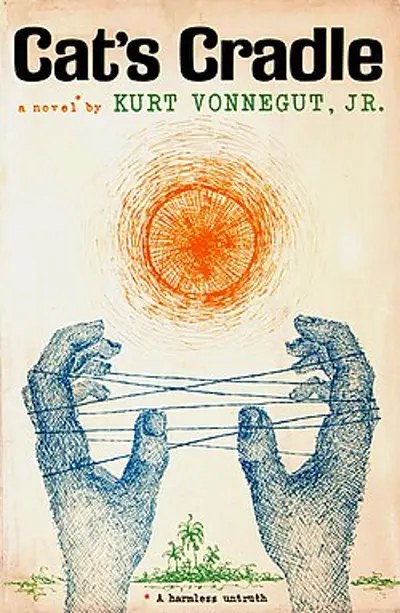
Cat's Cradle (1963)
Kurt Vonnegut
- Reviewed
- Reviewed 29 Jul 2026
Rated 4.0 out of 5.
Overall
Rated 5.0 out of 5.
Narration
A book about the end of the world by ice, told by a narrator who set out to write about the day the first bomb dropped and ended up somewhere else entirely. Spoilers from here.
The plot is ice-nine. Felix Hoenikker, who helped build the bomb and cared about neither, also made a crystal that teaches water to freeze at room temperature. He dies and his three children quietly split it between them. Frank trades his share for a government job on San Lorenzo, and from there it takes about a page to get into the sea and freeze the planet. Funny and thought provoking, as advertised.
But the book is not really about that. The book is Bokononism, and everything else is scaffolding around it.
The best thing in it is how the religion got made. Bokonon and McCabe wash up on San Lorenzo and try to fix the place honestly. It cannot be fixed, it is poor and there is nothing there. So they build a lie instead: Bokonon goes into the jungle as the outlawed holy man, McCabe stays and plays the tyrant who hunts him and threatens everybody with the hook. Neither of them believes it. It is theatre, invented deliberately to give people something to be, and it works. The island is happier for it.
And then it eats them both. The roles were supposed to be costumes and after a few years there is no man left underneath. McCabe goes mad and Bokonon goes mad. That is the part I keep thinking about. You cannot perform a thing that long and stay outside it.
The other thing that stuck is karass against granfalloon. A karass is the team you are actually working on something with, arranged without your knowledge and invisible to you. A granfalloon is the same thing but false: your nation, your company, your Hoosiers. Once you have the word you start seeing granfalloons everywhere, which I suspect is the whole point of giving it a word.
What holds the book back is everything that is not Bokonon. The Hoenikkers are sketches, Mona barely exists as a person, San Lorenzo is scenery. The novel is at its best when it stops entirely and quotes The Books of Bokonon at you. I said about The Moon is a Harsh Mistress that didactic prose is a feature when the ideas are good, and this is the same case, except here the ideas are so much better than the story carrying them that the story starts to feel like an excuse.
The ending earns it back. Bokonon on the mountain, world already frozen to death, saying that if he were younger he would write a history of human stupidity, climb up here, take ice-nine, lie on his back and grin, and thumb his nose at You Know Who. The man who spent his life writing lies he told you were lies, going out with a gesture instead of an argument.
Which leaves the question the book is actually asking: he built foma so people could be brave and happy, and it worked right up until the world ended anyway. Does that make him a fraud or the only honest man in the book?
On the narattion: its really spot on.