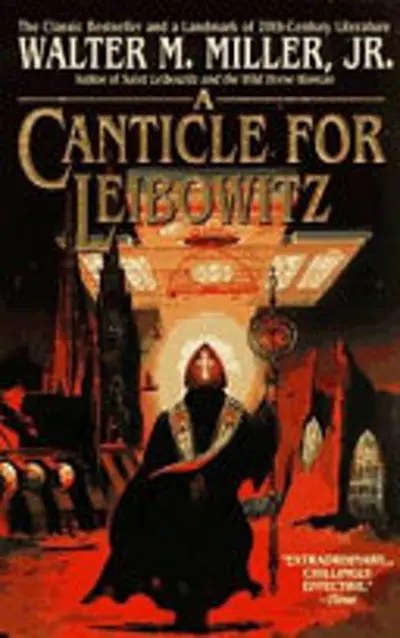
A Canticle For Leibowitz
W. M. Miller
- Published
- 2000
- Reviewed
- Reviewed 1 Aug 2026
Rated 5.0 out of 5.
Overall
Rated 3.5 out of 5.
Narration
Orm — this one did something to me.
What this meansSynopsis — skip if you already read the book (most likely LLM generated)
After a nuclear war called the Flame Deluge, survivors turned on the educated: the Simplification burned the books and killed the men who could read them. Isaac Leibowitz, an engineer who had worked on the weapons, founded a monastic order in the Utah desert to hide what was left. His monks became copyists of the Memorabilia — blueprints, memos, circuit diagrams, a shopping list — texts they preserve faithfully and cannot understand.
Fiat Homo (c. 2600): a novice finds a fallout shelter containing relics of the founder, and spends years illuminating a wiring diagram as a sacred document.
Fiat Lux (c. 3170): a secular scholar arrives to study the collection just as a monk rebuilds a working electric lamp from it. Knowledge passes out of the abbey’s hands and into the world’s, where the states are already arming.
Fiat Voluntas Tua (c. 3780): spaceflight, colonies, and nuclear weapons again. The order prepares for what it has seen before.
Three part novel, post-nuclear, monks in Utah abbey perserving fragments they can't understand, scraps of notes and diagrams, spannig roughly 1200 years
What got me was the preservation of knowledge and the restoration of this knowledge. The deep misunderstanding, but the will to preserve it. This is the strongest part of the book, combined with the life of the monks which is deeply rooted in tradition. They turn a circuit diagram into sacred art and they venerate a shopping list. The author never describes it mockingly. The Latin passages might irritate some readers. I had Latin in school and I was fascinated by how much came back. Through the ages bits of this knowledge are restored over centuries from electric light until mankind crawls back to the stars. Then Lucifer returns. So the wheel turns another round. I am not sure if mankind is redeemed in the end or finally mocked; if the Catholic faith is a consolation or a complication to it all. The acts of the monks themselves and maybe the acts of all mankind bore their destruction in them from the very start. The monks preserve faithfully, and what they preserve is the bomb. Their fidelity is the mechanism of the next destruction. In the end a dying abbot is given communion by a two-headed mutant he takes for a creature born without sin. Whether that is grace or the cruelest joke in the book, Miller refuses to say.